
Clinical review: Dr. Johanna Calderón, specialist in periodontics and dental implants. Updated July 22, 2026.
Quick answer: how much does a dental implant cost in 2026?
A complete conventional dental implant costs between $3.800.000 and $4.500.000 COP. This price includes the implant fixture or screw, abutment, crown, surgery, and follow-up appointments related to the treatment.
- Single implant fixture or screw: $2.000.000 to $2.300.000 COP.
- Porcelain-fused-to-metal crown with abutment included: $1.800.000 to $1.900.000 COP.
- Zirconia crown with abutment included: $2.000.000 to $2.200.000 COP.
- Complete conventional dental implant: $3.800.000 to $4.500.000 COP.
- Strategic implantology for anterior teeth or premolars: $4.800.000 COP for the two phases described in this guide.
- Strategic implantology for one isolated molar: $5.800.000 COP for the two phases described in this guide.
The abutment is included in the crown price, surgery is included, and follow-up appointments related to the treatment have no additional cost. The quote may increase when the diagnosis indicates procedures that not every patient needs, such as bone regeneration, sinus lift surgery, sedation, or previous periodontal treatment.
Clinical fees are the same in Bogotá, Cali, Medellín, Ibagué, Barranquilla, Cartagena, and Pereira when the diagnosis, technique, materials, and treatment scope are equivalent.
When someone searches for how much a dental implant costs, they often find advertisements with very different prices. The difference does not always mean that one clinic is less expensive or more expensive: many quotes simply do not include the same components.
This guide is for patients who live in Colombia and need prices in Colombian pesos, payment options, and availability by city.
Contact us
Office hours
Sat: 8:00 AM - 1:00 PM
1) Price of the implant, crown, and complete treatment
The expression “dental implant” may be used to describe different things. To compare quotes correctly, separate the following concepts:
- Implant: the component placed in the bone to replace the tooth root.
- Abutment: the connection between the implant and the crown.
- Crown: the visible part that replaces the tooth.
- Surgery: the procedure, materials, local anesthesia, and postoperative management required for the case.
- Follow-up appointments: later examinations, adjustments, and monitoring.
- Additional procedures: extraction, bone regeneration, sinus lift, soft-tissue management, or sedation when indicated.
Conclusion: asking only “how much is the implant?” may produce an incomplete answer. The correct question is: how much does the entire treatment cost, and what is included in writing?
2) Estimated price table for patients in Colombia
Estimated prices updated for 2026. The final quote depends on the clinical examination, diagnostic imaging, technique, and materials.
| Item | Estimated price | What you should confirm |
|---|---|---|
| Single implant fixture or screw | $2.000.000 – $2.300.000 COP | This is the implant component. Complete treatment also includes the abutment, crown, surgery, and follow-up appointments. |
| Conventional abutment | Included in the crown price | It is not charged as a separate item in the prices published by the clinic. |
| Porcelain-fused-to-metal crown with abutment included | $1.800.000 – $1.900.000 COP | Laboratory work, design, try-ins, and adjustments. |
| Zirconia crown with abutment included | $2.000.000 – $2.200.000 COP | Esthetic and functional indication according to the bite. |
| Complete conventional dental implant | $3.800.000 – $4.500.000 COP | Includes implant, abutment, crown, surgery, and follow-up appointments related to the treatment. |
| Treatment follow-up appointments | Included, with no additional cost | Frequency depends on the technique, healing, and clinical risk. |
| Simple extraction, when applicable | $150.000 – $350.000 COP | Complexity, management of the site, and follow-up care. |
| Bone regeneration or grafting, when applicable | $800.000 – $5.000.000 COP | Volume, biomaterials, membrane, and healing time. |
| Maxillary sinus lift, when applicable | $3.000.000 – $5.000.000 COP | Technique, anatomy, biomaterials, and follow-up care. |
| Conscious sedation, when applicable | $800.000 for the first hour and $600.000 for each additional hour | Anesthesiologist, monitoring, duration, and scope of the procedure. |
| Strategic implantology: anterior tooth or premolar | $4.800.000 COP | Two phases described later in this guide. |
| Strategic implantology: isolated molar | $5.800.000 COP | Two implants may be required to support one crown. |
Important: the prices on this page are the same for Colombian and international patients. Treatment is quoted according to diagnosis, not country of residence.
3) Estimate your budget by clinical scenario
There is no single price for every patient. The following situations explain why two people may receive different quotes:
Scenario A: one tooth is missing and there is enough bone
- Single implant fixture: $2.000.000 – $2.300.000 COP.
- Crown with abutment included: $1.800.000 – $2.200.000 COP, depending on the material.
- Surgery and treatment follow-up appointments included.
Complete conventional treatment ranges from $3.800.000 to $4.500.000 COP. When the diagnosis does not indicate grafting, sinus lift surgery, sedation, or previous periodontal treatment, this is the complete range published by the clinic.
Scenario B: the tooth still needs to be extracted
- Estimated simple extraction: $150.000 – $350.000 COP.
- The specialist determines whether the implant can be placed immediately or whether it is preferable to wait.
- The presence of infection and the condition of the bone and soft tissues may change the treatment plan.
Scenario C: there is bone loss
- Bone regeneration or grafting: $800.000 – $5.000.000 COP.
- Maxillary sinus lift: $3.000.000 – $5.000.000 COP, when indicated.
- Regenerative procedures may increase the total duration of conventional treatment.
Read our guide to bone regeneration for dental implants.
Scenario D: reducing treatment time in a selected case
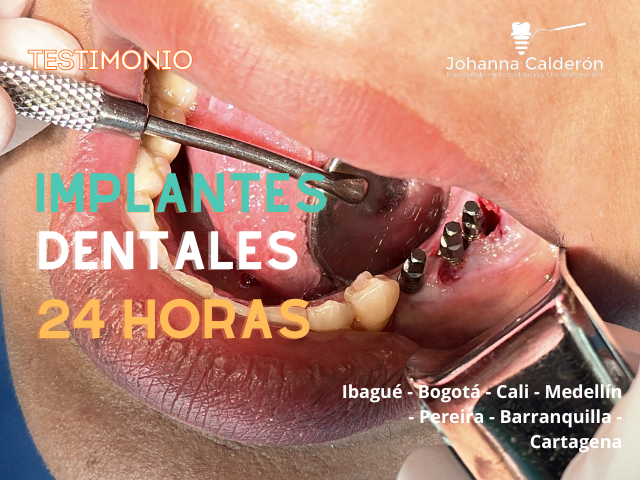
Immediate-loading strategic implantology may be considered to use cortical bone areas or compressive implants, reduce the need for grafting in many cases, and place a provisional fixed crown or prosthesis in approximately 24–48 hours when the diagnosis allows it.
4) What does a complete dental implant quote include?
| Item | Question you should ask | Why it matters |
|---|---|---|
| Diagnosis | Does it include the examination and required imaging? | This makes it possible to evaluate bone, gums, anatomy, and bite. |
| Implant | What are the brand, reference, and traceability? | This helps identify the system and its components. |
| Abutment | Is it included in the crown price? | At our clinic, it is included in the published crown price. |
| Crown | Is it porcelain-fused-to-metal, zirconia, or provisional PMMA? | The material changes the price and clinical indication. |
| Surgery | Does it include professional fees, materials, anesthesia, and sutures? | This helps prevent unexpected costs. |
| Additional procedures | What happens if an extraction, bone graft, or sinus lift is required? | They may change the price and treatment times. |
| Follow-up appointments | Which follow-up appointments are scheduled? | At our clinic, treatment-related follow-up appointments are included and have no additional charge. |
| Maintenance | What follow-up and hygiene care will be needed afterward? | This helps protect peri-implant health. |
5) Factors that influence the cost of a dental implant
Diagnosis and complexity
The amount and quality of bone, gum condition, presence of infection, bite, bruxism, and the area being restored all influence the technique and quote.
Implant system and traceability
It is not enough to classify an implant as “economical” or “premium.” You should know the brand, reference, component availability, system documentation, and supplier support. A lower price alone does not prove lower quality, just as a higher price does not guarantee a good result.
Crown material
Porcelain-fused-to-metal and zirconia have different characteristics, indications, and costs. The choice should consider the area, esthetic needs, available space, bite, and prosthetic design.
Experience of the team and treatment planning
The professional’s training, periodontal evaluation, surgical planning, and coordinated work with the laboratory are part of the value of treatment. No specialist can guarantee the complete absence of complications, but proper planning helps identify and manage risks.
Technology used
CBCT imaging, intraoral scanning, digital planning, and laboratory systems can improve the information obtained and the precision of the process. Technology should support clinical judgment, not replace it.
Additional procedures
Extractions, bone regeneration, sinus lift surgery, soft-tissue management, sedation, or special provisional prostheses may increase treatment cost and duration.
6) Conventional implantology vs. strategic implantology
| Aspect | Conventional implantology | Strategic implantology |
|---|---|---|
| Plan | A phased protocol with healing times based on the case. | An immediate-loading protocol for selected cases. |
| Initial prosthesis | Depends on stability, location, and planning. | May allow a provisional fixed crown or prosthesis within 24–48 hours. |
| Bone | May require regeneration when bone volume is insufficient. | Uses one-piece implants, and the clinic’s protocol is planned without bone grafting or sinus lifts. |
| Quote | Calculated according to the components and procedures required. | Published by phases for anterior teeth, premolars, and molars; no separate abutments or connectors are used. |
| Indication | A suitable alternative for many single-tooth and multiple-tooth cases. | Requires diagnosis and specific training; it is not suitable for everyone. |
There is no single technique that is universally better. The choice depends on the diagnosis, anatomy, bite, periodontal condition, medical conditions, and the patient’s goals.
7) 2026 costs of immediate-loading strategic implantology
The corticobasal or one-piece strategic implants used in this protocol are made as a single unit, so they do not require separate abutments or connectors. Planning is performed without bone grafting or sinus lift surgery within the strategic protocol applied by the clinic. The indication depends on clinical evaluation, CBCT imaging, bite, load distribution, and the patient’s medical conditions.
Anterior teeth or premolars
- Total cost per tooth: $4.800.000 COP.
- Phase 1, approximately 24–48 hours: $3.000.000 COP — implant + provisional fixed PMMA crown.
- Phase 2, between 8 and a maximum of 18 months according to the plan: $1.800.000 COP — replacement with a definitive zirconia crown.
Molars in high-load areas
For an isolated molar, treatment planning may indicate two implants to support one crown.
- Total cost per molar: $5.800.000 COP.
- Phase 1, approximately 24–48 hours: $4.000.000 COP — two implants + provisional fixed PMMA crown.
- Phase 2, between 8 and a maximum of 18 months according to the plan: $1.800.000 COP — replacement with a definitive zirconia crown.
Clinical clarification: when two consecutive molars are required, three implants may sometimes be placed to support two crowns. The indication depends on the diagnosis.
The molars mentioned generally correspond to teeth 16, 17, 26, 27, 36, 37, 46, and 47.

8) How much does a fixed full-arch implant prosthesis cost?
When all or almost all teeth are missing from one arch, the quote is not calculated by multiplying the price of a single implant. The number of implants, prosthetic material, loading protocol, and number of phases all change the total cost.
| Treatment per arch | Implants and material | First phase | Second phase | Total |
|---|---|---|---|---|
| Conventional All-on-4 | 4 implants and a definitive fixed acrylic prosthesis | $12.000.000 for implant placement | $12.000.000 at approximately 4 months for the fixed acrylic prosthesis | $24.000.000 |
| Conventional All-on-6 | 6 implants and a definitive fixed zirconia prosthesis | $14.000.000 for implant placement | $20.000.000 at approximately 4 months for the fixed zirconia prosthesis | $34.000.000 |
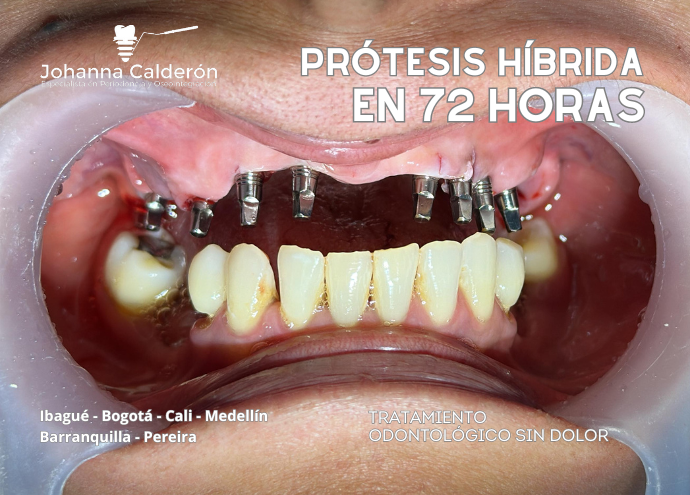
| Strategic acrylic All-on-X | 10 to 12 upper implants or 8 to 10 lower implants, with a fixed acrylic prosthesis | One phase completed in approximately 72 hours | No later conversion to zirconia is required | $31.000.000 |
| Strategic zirconia All-on-X | 10 to 12 upper implants or 8 to 10 lower implants, transitional PMMA and definitive zirconia | $25.000.000 for implants and a fixed transitional PMMA prosthesis | $16.000.000 between 8 and 24 months for the definitive zirconia prosthesis | $41.000.000 |
Bimaxillary rehabilitation: when both arches are treated, the prices are multiplied by two: All-on-4 $48.000.000, All-on-6 $68.000.000, strategic acrylic All-on-X $62.000.000, and strategic zirconia All-on-X $82.000.000.
- Extractions: included in the full-arch treatments described.
- Follow-up appointments: included with no additional treatment-related charge.
- Sedation: $800.000 for the first hour and $600.000 for each additional hour.
- Conventional protocols: grafting or sinus lift surgery is not included when required.
- Strategic protocol: does not use bone grafting, sinus lift surgery, or separate abutments.
Read the complete guide to All-on-4, All-on-6, and All-on-X in Colombia to learn about indications, differences, materials, phases, and treatment times.
9) How do you choose between a porcelain-fused-to-metal crown and a zirconia crown?
Porcelain-fused-to-metal
- Estimated range: $1.800.000 – $1.900.000 COP.
- It may be a functional alternative depending on the location and esthetic requirements.
- Available space, bite, and prosthetic design must be evaluated.
Zirconia
- Estimated range: $2.000.000 – $2.200.000 COP.
- It may provide esthetic advantages and good strength in many cases.
- The indication depends on the rehabilitation, laboratory, and chewing loads.
The most expensive crown is not automatically the best choice for everyone. Selection should be based on diagnosis and the complete rehabilitation design.
10) How much does a dental implant cost in Bogotá, Cali, Medellín, and other cities?
The published clinical fee is the same at our locations when the diagnosis, technique, materials, and scope of treatment are equivalent. Therefore, a complete conventional dental implant ranges from $3.800.000 to $4.500.000 COP in Bogotá, Cali, Medellín, Ibagué, Barranquilla, Cartagena, and Pereira.
Appointment availability, the clinical team, laboratory, and logistics may vary by location. Before traveling, confirm the date, city, professional, included components, and treatment schedule in writing.
| City | Complete conventional dental implant | Location information |
|---|---|---|
| Bogotá | $3.800.000 – $4.500.000 COP | View the dental office in Bogotá |
| Cali | $3.800.000 – $4.500.000 COP | View the dental office in Cali |
| Medellín | $3.800.000 – $4.500.000 COP | View the dental office in Medellín |
| Ibagué | $3.800.000 – $4.500.000 COP | View the dental office in Ibagué |
| Barranquilla | $3.800.000 – $4.500.000 COP | View the dental office in Barranquilla |
| Cartagena | $3.800.000 – $4.500.000 COP | View the dental office in Cartagena |
| Pereira | $3.800.000 – $4.500.000 COP | View the dental clinic in Pereira |
Looking for an upcoming appointment? Ask about evaluation availability in your city this week. Scheduling depends on the location and the professional required for your treatment.
11) Payment and financing options for dental implants
Treatment may be organized according to its clinical phases. Available options must be confirmed before treatment begins and may include card payments, payments by treatment stage, and financing through partner institutions, subject to review, approval, rates, and terms established by third parties.
Examples of payments by clinical phase
| Treatment | First phase | Second phase | Total |
|---|---|---|---|
| Strategic anterior tooth or premolar | $3.000.000: implant and provisional fixed PMMA crown | $1.800.000: definitive zirconia crown between 8 and 18 months | $4.800.000 |
| Strategic isolated molar | $4.000.000: two implants and a provisional fixed PMMA crown | $1.800.000: definitive zirconia crown between 8 and 18 months | $5.800.000 |
| All-on-4 per arch | $12.000.000: placement of four implants | $12.000.000 at approximately 4 months: fixed acrylic prosthesis | $24.000.000 |
| All-on-6 per arch | $14.000.000: placement of six implants | $20.000.000 at approximately 4 months: fixed zirconia prosthesis | $34.000.000 |
| Strategic zirconia All-on-X | $25.000.000: implants and a fixed transitional PMMA prosthesis | $16.000.000 between 8 and 24 months: definitive zirconia prosthesis | $41.000.000 |
Before accepting financing
- Request the total cost of both the treatment and the financing.
- Confirm the number of installments, interest rate, administrative fees, and late-payment conditions.
- Verify whether the funds are paid directly to the clinic.
- Ask what happens if the diagnosis changes or an additional procedure becomes necessary.
- Request the financial institution’s terms in writing.
Financing does not change the clinical indication. Treatment must be planned according to the diagnosis, not according to the amount approved by a financial institution.
12) EPS health plans, prepaid medical plans, and insurance: do they cover dental implants?
Coverage depends on the contract, exclusions, cause of tooth loss, and clinical indication. Do not assume that a plan covers or excludes treatment without reviewing its terms.
- Ask the EPS health insurer, insurance company, or prepaid medical plan directly.
- Request a written answer or authorization.
- Ask whether it covers the evaluation, imaging, surgery, implant, crown, or only certain components.
- Confirm whether there is a specific provider network.
13) How to compare two dental implant quotes correctly
A lower quote may include fewer components. Use this list before deciding:
- Compare the same number of implants and crowns.
- Verify that the abutment is included in the crown price.
- Compare the crown material.
- Check whether surgery, follow-up appointments, and a provisional prosthesis are included.
- Ask about extractions, grafting, sinus lift surgery, and sedation.
- Request the implant system brand and reference.
- Review the maintenance plan and warranty terms.
- Confirm the total cost and payment methods in writing.
14) Myths and facts about dental implant prices
Myth: “The advertised price always includes everything”
Fact: it may refer only to the implant fixture or screw. At our clinic, the $3.800.000 to $4.500.000 range corresponds to complete conventional treatment and includes the abutment, crown, surgery, and follow-up appointments.
Myth: “The most expensive treatment is always the best”
Fact: price does not replace diagnosis, training, planning, traceability, or follow-up care.
Myth: “Every patient needs a bone graft”
Fact: the need depends on anatomy and technique. Some conventional cases require regeneration, while certain cases may be treated with strategic alternatives.
Myth: “Teeth in 24 hours means immediate definitive zirconia”
Fact: in the protocols described, immediate loading usually begins with a provisional fixed PMMA prosthesis. The definitive phase is completed later.
Myth: “A dental implant lasts a lifetime without maintenance”
Fact: no result can be guaranteed for life. Hygiene, periodontal control, smoking, diabetes, bruxism, and follow-up appointments affect longevity.
Myth: “The price necessarily changes from one city to another”
Fact: at our locations, the price depends on diagnosis, technique, and materials. The city does not change the fee when the clinical scope is equivalent.
15) Step by step: what is paid during treatment
Evaluation and diagnosis
- Examination of teeth, gums, and bite.
- Review of imaging and medical history.
- Definition of the technique, materials, and schedule.
Surgical phase
- Implant placement.
- Extraction or additional procedures when indicated.
- Medications and follow-up appointments according to the prescription.
Prosthetic phase
- Abutment included in the crown price, records, try-ins, and design.
- Provisional or definitive crown according to the protocol.
- Bite adjustment.
Follow-up and maintenance
- Soft-tissue and prosthetic follow-up.
- Oral hygiene education.
- Individualized maintenance according to risk factors.
16) Maintenance: the cost that protects your treatment
The implant itself does not develop cavities, but the tissues around it can become inflamed or diseased. Periodic maintenance helps detect bleeding, plaque, overload, or prosthetic changes.
Signs that require an evaluation
- Bleeding or inflammation around the implant.
- Persistent bad odor or bad taste.
- Pain when biting.
- Movement of the crown or prosthesis.
- A change in the bite.
The frequency of follow-up visits depends on individual risk. A history of periodontitis, smoking, diabetes control, and bruxism must be considered during follow-up.
17) How we prepare and update this price guide
The published prices are based on the treatments, components, and materials used by the clinic. Dr. Johanna Calderón clinically reviews the information, and the ranges are updated when costs, materials, or protocols change.
This guide does not use a generic internet average to establish a patient’s quote. Its purpose is to explain transparently what treatment may include and why the individual diagnosis may change the final price.
18) Cases and experiences of patients treated in Colombia
Results must be evaluated individually. To protect privacy, we publish images, videos, or testimonials only when the patient has provided authorization.
You can view the treatment and clinical case gallery and our YouTube channel.
Note: another patient’s experience does not guarantee the same result, recovery time, or clinical response. Prognosis depends on diagnosis, medical history, hygiene, technique, and follow-up care.
Real testimonials from patients treated with dental implants
While we continue adding cases from patients who live in Bogotá, Cali, Medellín, Ibagué, Barranquilla, Cartagena, and Pereira, we present three real experiences from patients treated by our team in Colombia. The cases are published with authorization and show different treatments: dental implants and crowns, an upper fixed prosthesis, and full-mouth bimaxillary rehabilitation.
Important: testimonials describe personal experiences. They do not guarantee that every patient will have the same result, pain level, swelling, recovery time, or treatment duration. Every plan depends on the clinical evaluation, diagnostic imaging, medical history, bite, and individual response.
John J. Martin — upper fixed prosthesis supported by ten implants
Origin: Colombian patient living in the United States.
Treatment performed: a fixed full-arch implant prosthesis in the upper jaw, supported by ten implants. This plan may be described as an All-on-10 rehabilitation and is not an All-on-4.
Treatment time: the immediate rehabilitation phase was completed in approximately 72 hours according to his clinical plan.
“I have had dental problems for as long as I can remember and could not smile comfortably. They simply took care of me and did a wonderful job. Everything was so fast; I was amazed. It was about three days, and now I am smiling. I had not seen my smile in such a long time. I have no words; I cannot describe it.”
Tiara Willys — dental implants and crowns
Origin: American patient living in the United States.
Treatment performed: dental implants and crowns.
Treatment time: the rehabilitation phase was completed in approximately 72 hours according to the treatment plan established for her case.
“I contacted them through social media, and they helped me coordinate everything. I came to have implants placed, and everything went very well. I did not have much pain, and recovery was very good. They placed my implants yesterday, and today I do not have much swelling or pain. The staff was good. If you need to get started, contact Dr. Johanna Calderón.”
Jeannette Blanco — full-mouth bimaxillary rehabilitation
Origin: born in Cuba and living in Miami, United States.
Treatment performed: fixed full-mouth rehabilitation, also known as a bimaxillary full-arch implant prosthesis.
Treatment time: the immediate rehabilitation phase was completed in approximately 72 hours according to her clinical plan.
“The process was a complete adventure: the warmth and humanity were incredible. It felt as though they had known me all my life. The work was wonderful; I have regained my self-esteem, happiness, and confidence. I am extremely happy and grateful for the work they did for me, and I will always carry that here, in my heart.”
Editorial note: the quotations were adjusted only for punctuation and spelling to make them easier to read, without changing the meaning expressed by the patients.
More cases and experiences
View more results, videos, and treatments performed by our team. As we receive new authorizations, this section will be updated with experiences from patients living in the cities where we provide care.
19) Related scientific evidence
- History of periodontitis and peri-implant risk: PubMed 30391683.
- Guided bone regeneration: PubMed 29368353.
- Implants associated with maxillary sinus lift procedures: PubMed 36511050.
- Immediate or early loading: PubMed 29703670.
- Zirconia versus metal-ceramic implant-supported prostheses: PubMed 38425320.
Note: scientific evidence guides clinical practice but does not replace an individual evaluation.
Would you like to know the actual cost of your case and appointment availability in your city?
The final price depends on the bone, gums, bite, area being restored, technique, and materials. Ask about evaluation availability in Bogotá, Cali, Medellín, Ibagué, Barranquilla, Cartagena, or Pereira to receive a treatment plan and itemized quote.
Related articles
Frequently asked questions about dental implant prices and financing
How much does a complete dental implant cost?
A complete conventional dental implant costs between $3.800.000 and $4.500.000 COP. It includes the implant fixture or screw, abutment, crown, surgery, and follow-up appointments related to the treatment. The quote may increase if the diagnosis indicates bone regeneration, sinus lift surgery, sedation, or previous periodontal treatment.
Is the abutment included in the crown price?
Yes. In the prices published by our clinic, the conventional abutment is included in the crown price and is not charged as a separate item.
Do dental implant follow-up appointments have an additional cost?
No. Clinical follow-up appointments related to the treatment performed are included. Frequency depends on the technique, healing, periodontal risk, and the patient’s progress.
How much does a dental implant cost in Bogotá?
Complete conventional treatment costs between $3.800.000 and $4.500.000 COP at the Bogotá location when no additional procedures are required. The final price is confirmed after the evaluation, diagnostic imaging, and review of everything included in the treatment plan.
Is the price the same in Cali, Medellín, Ibagué, Barranquilla, Cartagena, and Pereira?
Yes. The published clinical fee is the same at our locations when the diagnosis, technique, materials, and scope are equivalent. Appointment availability, the clinical team, and logistics may vary between cities.
Can a dental implant be paid for in stages?
Yes, when treatment has clearly differentiated clinical phases. For example, strategic implantology, All-on-4, All-on-6, and All-on-X may distribute payments according to the surgical and prosthetic phases. The terms must be provided in writing before treatment begins.
Do you offer financing or card payments?
Card payments and financing alternatives through partner institutions may be available, subject to review, approval, rates, and terms defined by third parties. Before accepting financing, request the total credit cost, number of installments, and all fees.
Do EPS health plans or prepaid medical plans cover dental implants?
Coverage depends on the contract, exclusions, cause of tooth loss, and clinical indication. Request a written response directly from the EPS health insurer, insurance company, or prepaid medical plan specifying whether it covers the evaluation, imaging, surgery, implant, crown, or another component.
Which procedures may increase the cost?
Bone regeneration, maxillary sinus lift surgery, sedation, previous periodontal treatments, soft-tissue management, and other diagnosis-based procedures may change the quote. The strategic protocol applied by the clinic does not use bone grafts or sinus lifts.
How much does strategic implantology cost?
Strategic treatment for an anterior tooth or premolar costs $4.800.000 COP: $3.000.000 in the first phase and $1.800.000 in the definitive phase. For an isolated molar, it costs $5.800.000: $4.000.000 in the first phase and $1.800.000 in the second phase.
How much does All-on-4, All-on-6, or All-on-X cost per arch?
Conventional All-on-4 costs $24.000.000 COP; conventional All-on-6 costs $34.000.000; strategic acrylic All-on-X costs $31.000.000; and strategic zirconia All-on-X costs $41.000.000. Each protocol uses different implants, materials, phases, and treatment times.
How much does conscious sedation cost?
Sedation may cost $800.000 COP for the first hour and $600.000 COP for each additional hour. Duration and indication depend on the procedure and medical assessment.
How do I know whether a dental implant offer is incomplete?
If it mentions only the implant screw and does not specify the abutment, crown, surgery, follow-up appointments, implant-system brand, additional procedures, maintenance, and warranty terms, request a complete written quote before deciding.

Author and clinical reviewer
Dr. Johanna Calderón
Specialist in periodontics and dental implants. At our clinic, we have a team of specialists that provides comprehensive care in dental implants, periodontics, smile design, endodontics, and general dentistry.
We treat Colombian and international patients and create each plan according to bone condition, gum health, bite, and the area requiring rehabilitation.
Last article update and clinical review: July 22, 2026.