Specialist in Periodontics and Dental Implants
Updated on 07/18/2026
Quick answer: dental implant prices in Colombia in 2026
Quick answer: at our clinic, the dental implant component or “implant screw” has an estimated price range of COP $2,000,000 to $2,300,000, approximately USD 570 to USD 660. The implant-supported crown may cost between COP $1,800,000 and $2,200,000, approximately USD 515 to USD 630, depending on the material.
For conventional treatment, the complete price ranges from COP $3,800,000 to $4,500,000, approximately USD 1,090 to USD 1,290. This price includes the implant, the abutment, the crown, surgery, and treatment-related follow-up appointments. The abutment is included in the price of the crown, and follow-up appointments do not generate an additional charge. The budget may increase only when the diagnosis indicates procedures that not every patient needs, such as bone regeneration, maxillary sinus lift, sedation, or previous periodontal treatment.
With immediate-loading strategic implantology, the total price stated in this guide is COP $4,800,000 for anterior teeth or premolars and COP $5,800,000 for an isolated molar when two implants are clinically required. These amounts are approximately USD 1,370 and USD 1,660, respectively.
The same clinical fee for everyone: treatment prices are the same for Colombian and international patients when the diagnosis, technique, materials, and scope of treatment are equivalent. Dollar amounts are shown only to make comparison and travel planning easier; they do not represent an additional charge for living outside Colombia.
Currency conversion reference: to make this guide easier for international readers, we use a rounded editorial rate of USD 1 ≈ COP 3,500. The actual amount in dollars depends on the exchange rate, financial institution, and date of payment. Prices are estimates, and the final treatment plan and quote depend on the diagnosis.
Do you live outside Colombia?
This guide is for patients who live outside Colombia and are considering traveling to the country for dental treatment.
We do not charge a different fee based on nationality or country of residence. The clinical quote depends on the diagnosis and the treatment indicated. Flights, lodging, transportation, and other travel expenses are considered separately.
Quick 2026 guide, without confusion
When someone asks, “How much does a dental implant cost?” two different concepts are often mixed together:
- Cost per implant: the price of the implant component, or “implant screw.”
- Cost of a complete dental implant: implant + abutment + crown + surgery + follow-up appointments.
There is also an important distinction that helps prevent confusion: at our clinic, we use two implantology techniques with different
timelines and costs:
- Conventional implantology, which follows a traditional staged protocol.
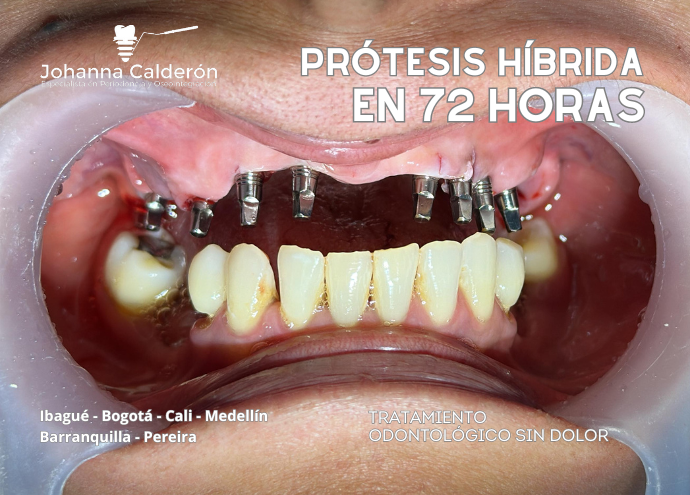
- Immediate-loading strategic implantology, using corticobasal and/or compression implants, which may allow fixed provisional crowns for one or a few teeth within 24–48 hours, or a full-arch fixed prosthesis in approximately 48–72 hours, in selected cases.
Implant component versus complete treatment
Per implant usually refers to the price of the implant component or “implant screw.” Many offers are advertised this way, and patients later discover that parts or services are missing.
In practice, the patient ultimately pays for the complete implant treatment, which usually includes:
- Implant
- Abutment or connector
- Crown, the visible “tooth”
- Surgery + follow-up appointments
In the prices published by our clinic for conventional implantology, the abutment is included in the cost of the crown, surgery is included, and treatment-related follow-up appointments do not have an additional cost. The items that may increase the quote, only when indicated by the diagnosis, are bone regeneration, maxillary sinus lift, sedation, and previous periodontal treatment.
This breakdown mainly applies to multi-component conventional implantology: the implant, abutment or prosthetic connector, and crown are separate components. Depending on the anatomy and available bone volume, this technique may require bone regeneration, bone grafting, or a maxillary sinus lift.
Corticobasal or one-piece strategic implantology is designed differently: it uses one-piece implants, so there is no separate abutment or additional connector. In the strategic protocol used by our clinic, bone grafts and maxillary sinus lifts are not performed to resolve the case; treatment planning seeks cortical or compression anchorage according to the available bone.
In this same guide, you will find a breakdown of the components, clinical scenarios, strategic implantology prices, travel timelines, and the points an international patient should review before comparing treatment quotes.
Do you currently live in Colombia? You may also read our guide for local patients about the complete price of a dental implant, financing, and additional costs.
2026 prices in COP and USD: conventional and strategic implantology
Estimated ranges may vary according to diagnosis, complexity, and materials. Clinical fees are the same for Colombian and international patients; the USD column is an informative conversion using an editorial reference of USD 1 ≈ COP 3,500.
| Technique or item | Price in COP | Approximate USD | What it includes or means | Important clinical difference |
|---|---|---|---|---|
| Conventional: implant component or implant screw | $2,000,000 – $2,300,000 | USD 570 – USD 660 | This is the implant component itself. It should not be confused with the complete treatment. | The conventional system has multiple components. In the prices published by the clinic, the abutment is included in the crown price, surgery is included, and follow-up appointments do not generate an additional charge. |
| Conventional: abutment | Included in the crown price | No separate additional cost | This is the connector between the conventional implant and the crown. At our clinic, it is included in the published crown price. | In one-piece strategic implantology there is no separate abutment because the implant and abutment are manufactured as one piece. |
| Porcelain-fused-to-metal crown with abutment included | $1,800,000 – $1,900,000 | USD 515 – USD 545 | Includes the crown and its corresponding abutment. It may be a functional and more affordable option, depending on the area and indication. | The material is selected according to the bite, esthetic requirements, gum condition, and prosthetic design. |
| Zirconia crown with abutment included | $2,000,000 – $2,200,000 | USD 570 – USD 630 | Includes the definitive crown and its corresponding abutment, offering high esthetics and strength in many cases. | Zirconia is used for the definitive phase of the strategic cases described in this guide. |
| Complete conventional dental implant | $3,800,000 – $4,500,000 | Approx. USD 1,090 – USD 1,290 | Includes the implant, abutment, crown, surgery, and treatment-related follow-up appointments. | Does not include bone regeneration, maxillary sinus lift, sedation, or previous periodontal treatment when indicated. |
| Treatment follow-up appointments | Included | No additional cost | Includes the scheduled clinical follow-up appointments related to the treatment performed. | The frequency depends on the technique, healing, and the patient’s clinical risk. |
| Simple extraction, when applicable | $150,000 – $350,000 | USD 45 – USD 100 | When a tooth must be removed before or during the implant treatment plan. | The complexity of the extraction may change the quote. |
| Conventional: bone regeneration or bone graft, when applicable | $800,000 – $5,000,000 | USD 230 – USD 1,430 | Indicated when a conventional implant requires additional bone volume. Learn more about bone regeneration. | This is not part of the corticobasal or one-piece strategic implantology protocol used by the clinic. |
| Conventional: maxillary sinus lift, when applicable | $3,000,000 – $5,000,000 | USD 860 – USD 1,430 | An additional procedure in the upper jaw when a conventional treatment plan requires more bone height. | It is not used to resolve cases treated with the clinic’s corticobasal or one-piece strategic protocol. |
| Conscious sedation, when applicable | $800,000 for the first hour and $600,000 for each additional hour | USD 230 for the first hour and USD 170 for each additional hour | May be considered for anxiety or longer procedures. Learn more about conscious sedation. | Confirm whether the price includes the anesthesiologist, monitoring, and medications. |
| One-piece strategic implant: anterior tooth or premolar | $4,800,000 | Approx. USD 1,370 | Total price for the two phases described in this guide: one-piece implant, fixed provisional PMMA crown, and later replacement with a definitive zirconia crown. | No separate abutment or additional prosthetic connector is used; the protocol does not require a bone graft or sinus lift. |
| One-piece strategic implant: isolated molar | $5,800,000 | Approx. USD 1,660 | Total price for both phases. Depending on chewing load, two one-piece implants may be required to support one crown. | No separate abutments, bone grafts, or sinus lifts are used within the strategic protocol. |
- Conventional implantology: a multi-component system. In the prices published by our clinic, the abutment is included in the crown price, surgery and follow-up appointments are included, and additional procedures are added only when indicated by the diagnosis. Depending on the case, bone grafting or a sinus lift may be required.
- Corticobasal or one-piece strategic implantology: one-piece implants without a separate abutment. In the protocol used by the clinic, bone grafts and maxillary sinus lifts are not required to resolve the case.
Important: there is no surcharge for being an international patient. Differences between quotes should be explained by the diagnosis, number of implants, technique, materials, prosthesis, and clinical procedures—not by nationality.
How much does a fixed full-arch implant prosthesis or full-mouth rehabilitation cost?
When all or nearly all teeth are missing from one jaw, the treatment price is not calculated by multiplying the cost of a single implant. A full-arch rehabilitation requires defining the number and type of implants, the prosthetic material, whether one arch or both jaws will be treated, the loading protocol, and the possible need for additional procedures.
The clinical prices for these rehabilitations are the same for Colombian and international patients. The conversion to dollars is published only to make planning easier. There is no surcharge based on nationality or country of residence.
Quick table: All-on-4, All-on-6, and All-on-X per arch
| Treatment per arch | Number of implants | Prosthetic material | First phase | Second phase | Total in COP | Approximate USD |
|---|---|---|---|---|---|---|
| Conventional All-on-4 | 4 implants | Definitive fixed acrylic prosthesis | $12,000,000: implant placement | $12,000,000 approximately 4 months later: fitting of the fixed acrylic prosthesis | $24,000,000 | Approx. USD 6,860 |
| Conventional All-on-6 | 6 implants | Definitive fixed zirconia prosthesis | $14,000,000: implant placement | $20,000,000 approximately 4 months later: fitting of the fixed zirconia prosthesis | $34,000,000 | Approx. USD 9,715 |
| Strategic All-on-X with acrylic prosthesis | 10 to 12 implants in the upper jaw or 8 to 10 in the lower jaw | Fixed acrylic prosthesis | One phase: implants and fixed prosthesis in approximately 72 hours | No additional prosthetic phase is required when the definitive acrylic option is chosen | $31,000,000 | Approx. USD 8,860 |
| Strategic All-on-X with zirconia prosthesis | 10 to 12 implants in the upper jaw or 8 to 10 in the lower jaw | Transitional PMMA and definitive zirconia prosthesis | $25,000,000: implants and a fixed transitional PMMA prosthesis in approximately 72 hours | $16,000,000 between 8 and 24 months: replacement with the definitive zirconia prosthesis | $41,000,000 | Approx. USD 11,715 |
Editorial conversion: USD 1 ≈ COP 3,500. The actual dollar amount varies according to the exchange rate and financial institution.
Conventional All-on-4: four implants and a fixed acrylic prosthesis
Conventional All-on-4 treatment has a total cost of COP $24,000,000 per arch. In the first phase, four implants are placed and COP $12,000,000 is paid. Approximately four months later, after implant integration and stability have been reviewed, the definitive fixed acrylic prosthesis is fitted, and the remaining COP $12,000,000 corresponding to the second phase is paid.
- First phase: four implants.
- Second phase: definitive fixed acrylic prosthesis.
- Time between phases: approximately four months, depending on clinical progress.
- Prosthesis during healing: in conventional implantology, a removable prosthesis is most commonly used. An immediate fixed prosthesis can be considered only when the torque and stability achieved during surgery allow it.
- Bone grafts or sinus lift: not included and may be required depending on the diagnosis.
Conventional All-on-6: six implants and a fixed zirconia prosthesis
Conventional All-on-6 treatment has a total cost of COP $34,000,000 per arch. In the first phase, six implants are placed and COP $14,000,000 is paid. Approximately four months later, the second phase is performed by fitting the definitive fixed zirconia prosthesis for COP $20,000,000.
This protocol uses more implants to provide the support required for a zirconia rehabilitation. The final number, distribution, and feasibility of treatment depend on the CBCT scan, available bone, bite, and prosthetic planning.
- First phase: six implants.
- Second phase: definitive fixed zirconia prosthesis.
- Time between phases: approximately four months, depending on clinical progress.
- Bone grafts or sinus lift: not included and may be required in conventional implantology.
All-on-X with corticobasal or one-piece strategic implantology
The term All-on-X describes a fixed full-arch rehabilitation in which the number of implants is determined according to the needs of the jaw, load distribution, and prosthetic design. In the strategic protocol used by the clinic, approximately 10 to 12 one-piece implants are placed in the upper jaw and 8 to 10 implants in the lower jaw.
These implants are manufactured as one piece, do not use separate abutments or connectors, and the protocol is planned without bone grafts or maxillary sinus lifts.
Strategic All-on-X with a definitive acrylic prosthesis
This option costs COP $31,000,000 per jaw. It is completed in one phase: the implants and fixed acrylic prosthesis are placed in approximately 72 hours. Because acrylic is the definitive material selected, an additional temporary prosthesis and a second phase to change to zirconia are not required.
Strategic All-on-X with a definitive zirconia prosthesis
This option costs COP $41,000,000 per jaw and is completed in two phases:
- First phase: COP $25,000,000 for implant placement and a fixed transitional PMMA prosthesis in approximately 72 hours.
- Second phase: COP $16,000,000 to replace the PMMA prosthesis with the definitive zirconia prosthesis. This replacement is performed no earlier than 8 months and no later than 24 months, depending on clinical progress and the patient’s schedule.
Bimaxillary rehabilitation prices: upper and lower jaws
When treatment includes both jaws, the per-arch prices are multiplied by two.
| Bimaxillary rehabilitation | First phase | Second phase | Total in COP | Approximate USD |
|---|---|---|---|---|
| Conventional All-on-4, upper and lower jaws | $24,000,000 | $24,000,000 | $48,000,000 | Approx. USD 13,715 |
| Conventional All-on-6, upper and lower jaws | $28,000,000 | $40,000,000 | $68,000,000 | Approx. USD 19,430 |
| Strategic All-on-X with acrylic prostheses, both jaws | One phase | Not applicable | $62,000,000 | Approx. USD 17,715 |
| Strategic All-on-X with zirconia prostheses, both jaws | $50,000,000 | $32,000,000 | $82,000,000 | Approx. USD 23,430 |
What is included and what may be charged separately
| Item | Condition |
|---|---|
| Extractions | Included in the full-arch treatments described above. |
| Follow-up appointments | Included, with no additional treatment-related charge. |
| Sedation | COP $800,000 for the first hour and COP $600,000 for each additional hour. |
| Bone grafts and sinus lift | Not included in conventional All-on-4 or All-on-6 when required. They are not part of the corticobasal or one-piece strategic All-on-X protocol used by the clinic. |
| Conventional provisional prosthesis | A removable prosthesis is most commonly used during healing. Immediate fixed loading can be determined only when the torque and stability achieved during surgery allow it. |
| Strategic transitional PMMA prosthesis | Used when the patient chooses the strategic option with a definitive zirconia prosthesis. It is not required when acrylic is selected as the definitive material. |
| International patient | The clinical fee is the same as for a Colombian patient. Flights, hotel, meals, local transportation, and other travel expenses are calculated separately. |
Complete guide to All-on-4, All-on-6, and All-on-X
This section summarizes the prices so you can compare full-arch rehabilitation with a single dental implant. For a more detailed explanation of indications, differences, materials, number of implants, phases, and clinical cases, read our specialized guide.
Read the guide to All-on-4, All-on-6, and All-on-X in Colombia
How much can an international patient save by getting dental implants in Colombia?
Actual savings are not calculated by comparing only the advertised price of the implant. You must compare the total cost of treatment in your country of residence with the clinical cost in Colombia plus travel expenses.
Practical comparison formula:
Estimated savings = complete treatment quote in your country of residence − (complete treatment quote in Colombia + flights + lodging + transportation + meals + insurance or other travel-related expenses).
For the comparison to be valid, both treatment quotes should state at least:
- number and brand of implants;
- abutments or prosthetic components;
- type of crown or prosthesis;
- surgery and anesthesia;
- bone grafts or additional procedures;
- provisional and definitive prostheses;
- follow-up appointments, maintenance, and long-term care conditions.
2026 international comparison: Colombia vs. the United States, Canada, Spain, and the United Kingdom
To avoid misleading comparisons, the following table uses a complete single-tooth dental implant as the reference: implant fixture, abutment, crown, and surgical placement. Bone grafting, sinus lifts, sedation, and other diagnosis-dependent procedures are not included.
| Country | Published 2026 reference | Approximate USD equivalent | Comparable complete treatment in Colombia | Estimated clinical price difference before travel |
|---|---|---|---|---|
| United States | Aspen Dental publishes an average of USD 4,259, with an approximate range of USD 3,158 to USD 6,533. The reference includes the implant, abutment, crown, and placement. | USD 4,259 average reference | USD 1,090 to USD 1,290 | Approximately 70% to 74% before flights, lodging, and other travel expenses. |
| Canada | Aeva places a complete implant between CAD 3,500 and CAD 6,500, with a working midpoint close to CAD 5,000. | Approx. USD 3,559 using CAD 5,000 | USD 1,090 to USD 1,290 | Approximately 64% to 69% before travel. |
| Spain | Ferrus & Bratos publishes an approximate average of EUR 1,640 for a complete implant. | Approx. USD 1,875 | USD 1,090 to USD 1,290 | Approximately 31% to 42% before travel. |
| United Kingdom | TreatCompare reports a median of GBP 2,500 and a typical range of GBP 2,000 to GBP 3,500 for a complete implant. | Approx. USD 3,359 using the median | USD 1,090 to USD 1,290 | Approximately 62% to 68% before travel. |
Currency methodology: Colombia uses the editorial reference applied throughout this guide: USD 1 ≈ COP 3,500. Canada uses the CAD/USD rate published by the Bank of Canada on July 15, 2026. EUR and GBP conversions use European Central Bank reference rates dated July 17, 2026. Exchange rates change daily.
Sources reviewed in July 2026:
How to calculate real savings, including travel
The clinical price difference shown above is not automatically the final amount saved. Flights, lodging, local transportation, meals, travel insurance, and any future visit must be added.
Net savings = comparable price in your home country − (clinical price in Colombia + travel expenses).
Net savings percentage = net savings ÷ comparable price in your home country × 100.
Illustrative example using USD 1,500 in total travel expenses
This example uses the midpoint of a complete implant in Colombia, approximately USD 1,190, and a hypothetical total travel budget of USD 1,500. It is not an airfare or hotel quote.
| Country of residence | One complete implant | Four separate single-tooth implants |
|---|---|---|
| United States | Illustrative savings: approximately 37%. | Illustrative savings: approximately 63%. |
| Canada | Illustrative savings: approximately 24%. | Illustrative savings: approximately 56%. |
| Spain | In this example, one implant would not produce net savings after travel. | Illustrative savings: approximately 17%. |
| United Kingdom | Illustrative savings: approximately 20%. | Illustrative savings: approximately 53%. |
Important: the four-implant example refers to four separate single-tooth restorations. It must not be used to calculate All-on-4, All-on-6, All-on-X, or full-arch rehabilitation because those treatments have their own designs and prices. Actual savings depend on diagnosis, exchange rates, the written quote, departure city, and real travel expenses.
Colombia versus your country of residence: what to compare besides price
| Item | What to confirm in Colombia | What to confirm in your country |
|---|---|---|
| Clinical scope | Whether the quote includes the implant, abutment, crown, provisional restoration, surgery, and follow-up appointments. | Make sure the quote includes exactly the same components. |
| Materials | Implant brand and prosthetic material. | Brand, material, and dental laboratory included. |
| Timeline | Number of days and possible trips. | Number of appointments and total treatment duration. |
| Follow-up care | In-person and virtual follow-up appointments and the protocol for an emergency. | Cost and availability of local maintenance. |
| Non-clinical expenses | Flights, hotel, meals, and transportation should not be assumed to be included. | Travel, time away from work, and copayments. |
How many days should you stay in Colombia for dental implant treatment?
The length of stay depends on the number of teeth, technique, need for bone grafting, type of prosthesis, and the patient’s clinical response. There is no responsible single number of days that applies to every patient.
- Single conventional implant: may require a surgical phase and a later prosthetic phase. The time between phases depends on healing and the treatment plan.
- Immediate-loading strategic implantology: in selected cases, one or a few teeth may receive fixed provisional crowns in approximately 24–48 hours. For a full arch, a fixed prosthesis is usually fitted in approximately 48–72 hours when clinically appropriate; the definitive phase, if needed, is scheduled according to the chosen prosthesis and clinical progress.
- Full-arch rehabilitations: may require a longer stay, prosthetic try-ins, follow-up appointments, and adjustments. The schedule should be provided before flights are purchased.
- Cases involving infection, bone grafts, or additional procedures: may require more time and additional follow-up appointments.
Recommendation: do not book a return flight with the shortest possible margin. The clinical team should review your images and medical history and allow reasonable time for follow-up appointments and adjustments.
Summary of treatment timing and possible trips
| Treatment | First phase | Definitive phase | Trips that may be required |
|---|---|---|---|
| Conventional single implant | In-person evaluation and surgery. | The crown is scheduled after healing and integration are confirmed. | Two trips may be required. |
| Strategic single implant | Implant and fixed provisional crown in approximately 24–48 hours. | Definitive zirconia crown between 8 and 18 months, depending on progress. | Usually two phases when definitive zirconia is selected. |
| Conventional All-on-4 | Placement of four implants. | Definitive fixed acrylic prosthesis at approximately four months. | Usually two trips when implants can be placed at the first surgery; three may be needed if bone grafting must come first. |
| Conventional All-on-6 | Placement of six implants. | Definitive fixed zirconia prosthesis at approximately four months. | Usually two trips when implants can be placed at the first surgery; three may be needed if bone grafting must come first. |
| Strategic acrylic All-on-X | Implants and fixed acrylic prosthesis in approximately 72 hours. | No later zirconia conversion is required when definitive acrylic is selected. | One main treatment visit, plus indicated follow-up. |
| Strategic zirconia All-on-X | Implants and fixed transitional PMMA prosthesis in approximately 72 hours. | Definitive zirconia prosthesis between 8 and 24 months. | Usually two trips, without a routine bone-grafting phase. |
Note: timing is approximate. Your final itinerary is confirmed after reviewing X-rays, CBCT scans, medical history, bite, and prosthetic plan. Do not purchase tightly scheduled return flights before receiving the clinical itinerary.
Conventional All-on-4 or All-on-6: If any necessary grafting and implant placement can be completed together, the first stay may take 7–15 days, depending on the procedure. The definitive fixed prosthesis is generally planned 4–6 months later, with approximately 10 days for fabrication, fitting and checks. If grafts must be completed before implant placement, three trips may be needed: a first stay of about 7–15 days for grafting; a second stay of about 5–7 days for implant placement roughly 6–9 months later; and a third stay of about 10 days for the definitive prosthesis approximately 4 months after implant placement. After sinus-lift surgery, the team may recommend around two weeks without a removable prosthesis to protect the graft. These are planning estimates, not a fixed itinerary.
Strategic full-arch implants: When definitive acrylic is selected, treatment generally takes one 7–10-day visit; the fixed prosthesis may be fitted in approximately 48–72 hours, with the remaining time for checks and adjustments. When zirconia is selected, the first 7–10-day visit includes a fixed transitional PMMA prosthesis, generally fitted in approximately 48–72 hours. A second 7–10-day visit for definitive zirconia is planned no sooner than 8 months later and may be scheduled up to approximately 24 months later, depending on healing and the patient’s availability. The full-arch treatment timeline explains each scenario in more detail. Clinical assessment and imaging determine the individual plan.
How many trips may be necessary?
- First trip: in-person evaluation, diagnostic confirmation, surgery, and a provisional prosthesis when indicated.
- Follow-up appointments: scheduled according to the procedure. Some follow-up care may be supported by video call, but this does not replace an in-person examination when there is pain, mobility, infection, or another complication.
- Second trip: may be necessary for the definitive prosthesis, especially when the rehabilitation is completed in two phases.
- Third trip in some conventional full-arch cases: when grafting must be completed before implants are placed, separate visits may be needed for grafting, implant placement, and the definitive prosthesis.
How to request initial guidance before traveling
Before buying airline tickets or booking lodging, you may send information for an initial review. This evaluation helps estimate the type of treatment and organize the visit more effectively, but it does not replace the in-person clinical examination.
Recommended records and images
- a recent panoramic X-ray;
- a cone-beam CT scan when already available;
- front-view, smile, and intraoral photographs of the affected areas;
- a list of medications;
- medical and dental history;
- information about diabetes, smoking, anticoagulants, allergies, periodontal disease, bruxism, or previous surgeries;
- a previous quote or diagnosis, when available.
Send your X-ray or CBCT scan for initial guidance
Remote guidance is preliminary. The diagnosis, final number of implants, and definitive quote are confirmed after the in-person examination and the required diagnostic imaging.
International patient support: what we can help coordinate
In addition to clinical guidance, our team can help organize practical parts of your visit. Availability, city, terms, and any non-clinical costs are confirmed before reservations are made.
| Support | How it is coordinated | What you should confirm |
|---|---|---|
| Pre-travel guidance | Preliminary review of X-rays, CBCT scans, photographs, medical history, and video consultation when necessary. | The definitive diagnosis and quote are confirmed in person. |
| Clinical itinerary | Coordination of evaluation, surgery, prosthetic try-ins, and follow-up according to treatment. | Number of days, clinic location, and possible later trips. |
| Airport transfer | May be coordinated depending on the city and availability. | Confirm in writing whether it is included or carries an additional cost. |
| Accommodation | We can provide guidance on areas, hotels, or reservation support. | Lodging is paid separately unless a written proposal states otherwise. |
| Bilingual assistance or interpreter | May be arranged for patients who do not speak Spanish, subject to availability. | Language, schedule, and possible cost. |
| Restaurant and activity guidance | The team may share general recommendations based on the city and post-procedure restrictions. | These activities are not part of clinical treatment. |
| Follow-up after returning home | Virtual guidance and in-person follow-up according to the treatment plan. | A video call does not replace an in-person examination when there is pain, mobility, bleeding, infection, or an emergency. |
Clinical fees are the same for Colombian and international patients. USD conversions and travel information are provided to facilitate planning, not to apply a different fee based on nationality or country of residence. Flights, lodging, meals, transportation, and other non-clinical services are calculated separately unless expressly included in a written proposal.
Which expenses are usually included and which should be confirmed separately?
| Item | What to ask |
|---|---|
| Evaluation and imaging | Confirm whether the consultation, panoramic X-ray, or CBCT scan is charged separately. |
| Surgery and implants | Number, brand, components, and follow-up appointments included. |
| Provisional prosthesis | Material, expected duration, and included adjustments. |
| Definitive prosthesis | Material, estimated date, and whether a second trip is required. |
| Medications and sedation | Confirm whether they are included and who administers the sedation. |
| Travel | Flights, hotel, meals, transportation, and insurance should not be assumed to be included unless they are expressly listed in the written quote. |
Real cases and testimonials from international patients
The following cases show how dental care can be organized for patients who travel to Colombia. Every treatment is planned individually; timelines, materials, number of implants, phases, recovery, and results may vary according to the diagnosis.
Example of phased treatment planning
Country of residence: United States.
Clinical need: rehabilitation of three units on implants.
First phase: implant placement and initial rehabilitation during an approximately three-day stay, according to the individual treatment plan.
Reference investment for this case: approximately USD 4,000 for the initial phase and approximately USD 1,400 for the definitive zirconia phase.
Clarification: this case is presented as an example of clinical experience and treatment planning; it is not a general fee. Another patient may require a different number of implants, materials, procedures, and days of stay.
Important: these testimonials describe individual experiences. They do not guarantee that every patient will have the same result, level of pain, swelling, recovery time, or treatment duration. The indication and schedule depend on the clinical evaluation.
Jeannette Blanco — full-mouth bimaxillary rehabilitation
Background: born in Cuba and living in Miami, United States.
Treatment: fixed full-mouth rehabilitation, also known as a bimaxillary full-arch implant prosthesis.
Treatment time: immediate rehabilitation phase completed in 72 hours, according to her clinical treatment plan.
“The process was truly an adventure—there was such warmth and an incredible sense of humanity. It felt as though they had known me my whole life. The work was wonderful; I regained my self-esteem, my happiness, and my confidence. I am extremely happy and grateful for the work they did for me, and I will always carry that here, in my heart.”
John J. Martin — upper fixed prosthesis supported by 10 implants
Background: Colombian patient living in the United States.
Treatment: upper-jaw fixed full-arch implant prosthesis supported by 10 implants. This treatment plan may be described as an All-on-10 rehabilitation and is not an All-on-4.
Treatment time: immediate rehabilitation phase completed in 72 hours.
“I have had dental problems for as long as I can remember, and I could never smile comfortably. They simply took care of me and did an amazing job. Everything happened so fast—it left me speechless. It was about three days, and now I am smiling. I had not seen my smile in such a long time. I have no words; I cannot describe it.”
Tiara Willys — dental implants and crowns
Background: American patient living in the United States.
Treatment: dental implants and crowns.
Treatment time: immediate rehabilitation phase completed in 72 hours.
“I contacted them through social media, and they helped me coordinate everything. I came for dental implants, and everything went very well. They picked me up at the airport, and the entire process went smoothly. I did not have much pain, and recovery was very good. They placed my implants yesterday, and today I do not have much swelling or pain. The staff was good, and my interpreter was good. If you need to get the process started, contact Dr. Johanna Calderón.”
Oscar Cerna — full-mouth bimaxillary rehabilitation
Background: born in Honduras and living in Miami, United States.
Treatment: fixed full-mouth rehabilitation, also known as a bimaxillary full-arch implant prosthesis.
Treatment time: immediate rehabilitation phase completed in 72 hours.
“The process was fast, and I felt very well cared for. The doctors were excellent: they are there for you, they do not leave you alone, and they answer every question you may have. In my case, recovery went well; I had minimal pain and very little swelling. The process was very clean and organized. I recommend them.”
Zara Kanji — implants, crowns, and coordinated care from Canada
Background: born in Tanzania and living in Canada.
Treatment: dental implants, crowns, and an additional submental liposuction procedure.
Treatment time: immediate rehabilitation phase completed in 72 hours.
“Three things stand out about Dr. Johanna’s clinic: they are diligent, technologically advanced, and very affordable compared with Canada. There is an entire team behind the process that welcomes you to Colombia, makes sure your lodging is booked, recommends restaurants, and even helps with excursions. I came with my dog, and they took care of him too. I had several implants, I am extremely happy, and Dr. Johanna has a gentle touch: she is careful and diligent. I absolutely recommend coming to visit Colombia.”
Note about the quotations: the testimonials are presented with minor punctuation and spelling corrections to make them easier to read, without changing the meaning expressed by each patient.
View more cases and treatment results
Care in different cities across Colombia
The price should not be determined by the patient’s nationality or solely by the city. Case complexity, technique, implants, laboratory, prosthesis, and additional procedures have a greater impact than location.
View all clinics, cities, and contact information
| City | Information for organizing your evaluation |
|---|---|
| Ibagué | Confirm the surgical schedule, required imaging, and recommended length of stay. |
| Bogotá | Convenient for patients with international flight connections; confirm the exact clinic location and treatment schedule. |
| Cali | Availability depends on the procedure and the required clinical team. |
| Medellín | Confirm whether surgery, follow-up appointments, and the prosthetic phase will be completed at the same location. |
| Barranquilla, Cartagena, and Pereira | Confirm availability, specialist, laboratory, and treatment phases before booking your trip. |
Myths and facts about dental implant costs in Colombia
Myth 1: “The advertised price always refers to the complete implant treatment”
Fact: some advertisements show only the implant screw. Confirm the abutment, crown, surgery, provisional restoration, follow-up appointments, and any additional procedures.
Myth 2: “The least expensive treatment always provides the greatest savings”
Fact: an incomplete quote may increase later. Comparisons should use equivalent materials, phases, and follow-up care.
Myth 3: “Every patient can receive fixed teeth within 24 hours”
Fact: immediate loading depends on stability, available bone, bite, number of implants, prosthetic design, and general health. Not every patient is a candidate.
Myth 4: “If I travel to Colombia, I will need only one visit”
Fact: conventional full-arch treatment usually requires two trips and may require three when bone grafting must precede implant placement. The clinical itinerary should be established before traveling.
Myth 5: “The country or city alone determines safety”
Fact: safety depends on diagnosis, professional training, clinical protocols, sterilization, equipment, materials, and follow-up care.
Is it safe to travel to Colombia for dental implant treatment?
No surgical procedure is entirely free of risk. To reduce those risks, the patient should verify:
- the professional’s training and experience;
- a complete medical and dental history and diagnosis;
- appropriate diagnostic imaging;
- a written treatment plan with materials, phases, and alternatives;
- sterilization and emergency-management protocols;
- follow-up care after returning to the country of residence;
- clear instructions about medications, hygiene, and warning signs.
Choosing solely on price may lead to comparing treatments that are not equivalent. The decision should consider the clinical indication, experience, traceability of the components, and the ability to provide follow-up care.
How we prepare and review this price guide
This guide combines the estimated fees used by the clinic, experience with conventional and strategic implant treatments, review of materials and prosthetic phases, and scientific literature related to bone regeneration, immediate loading, prosthetic materials, and peri-implant maintenance.
- Clinical review: Dr. Johanna Calderón, specialist in periodontics and dental implants.
- Price updates: the ranges should be reviewed whenever materials, laboratory fees, components, or protocols change.
- Transparency: the price of the implant screw is distinguished from the cost of complete treatment.
- International conversion: USD figures are approximate and should be updated according to the exchange rate.
- Limitation: no table replaces an individual diagnosis or guarantees that a patient is a candidate for a specific technique.
Our commitment to clinical transparency
The reliability of this guide is based on the clinical review of Dr. Johanna Calderón, the clinic’s documented experience, authorized clinical cases, a clear methodology for explaining prices, traceable scientific sources, and regular updates to the information.
Scenario calculator: how to estimate your case
Think of the cost as a combination of “building blocks.” The base block is usually the implant + crown,
and then procedures may or may not be added according to your diagnosis: extraction, bone regeneration, maxillary sinus lift, sedation, and others.
Scenario A: simple conventional case, without bone grafting
In this scenario, the conventional components in the main table are added together: implant, abutment when quoted separately, crown, surgery, and follow-up appointments. The final range depends on the implant system, crown material, and items included.
- Component reference: implant component between COP $1,900,000 and $2,300,000, plus the selected crown and the other components in the treatment plan.
- Key point: do not compare only the combined price of the implant screw and crown. Confirm the abutment, surgery, follow-up appointments, and warranty in writing.
Scenario B: with a previous extraction
- Extraction: $150,000 – $350,000
- The implant + crown treatment plan is then added, according to the diagnosis
Scenario C: with bone loss requiring regeneration
When bone height or width is insufficient, a conventional implant may require a bone graft or regeneration. Learn more about:
Bone regeneration.
- Bone regeneration/graft: $800,000 – $5,000,000
- The implant + crown treatment plan is then added
- Impact: this may increase the treatment timeline and budget, and the type of graft may affect results and follow-up care. [R2]
Scenario D: an alternative for optimizing treatment time in selected cases
In certain cases, strategic implantology using cortical anchorage, compression implants, and immediate-loading protocols may be evaluated to avoid bone grafts in many cases and/or reduce clinical treatment time.
Read the guide:
Strategic implantology
and learn about the experience:
strategic implants in 24 hours.
| Scenario | What changes the treatment cost | What to request in the written quote |
|---|---|---|
| Simple case | Crown material, type of abutment, and follow-up care | Implant brand, whether the abutment is included, type of crown, and number of follow-up appointments |
| With extraction | Extraction complexity and management of the surgical site | Whether extraction, medication, and postoperative follow-up are included |
| With bone grafting/regeneration | Bone volume, biomaterials, and clinical time | Type of graft, membrane when applicable, and follow-up schedule |
| Maxillary sinus | Technique, biomaterial, and anatomical complexity | Whether the sinus lift, follow-up visits, timeline, and medication are included |
| Sedation | Procedure duration and clinical need | Whether the anesthesiologist and monitoring are included, according to the protocol, and the scope of the service |
Immediate-loading strategic implantology: what it is and when it is considered
In addition to conventional implantology, our clinic provides immediate-loading strategic implantology, also known as corticobasal implantology, and/or protocols using compression implants depending on the case.
⚠️ Important: this technique is not indicated only when there is insufficient bone.
At our clinic, it is used as a different protocol from conventional implantology to:
- Complete treatment without bone grafts or maxillary sinus lifts.
- Avoid separate abutments or connectors because corticobasal or one-piece implants are manufactured as a single piece.
- Reduce clinical treatment time.
- Provide fixed provisional crowns for one or a few teeth within 24–48 hours, or an initial fixed full-arch prosthesis in approximately 48–72 hours, when the case meets the immediate-loading criteria.
In strategic implantology:
- The implants are anchored in cortical bone, or compression implants are selected according to the available anatomy.
- The choice between basal and compression implants depends on the diagnosis and bone distribution.
- Because they are one-piece implants, the implant body and prosthetic portion form a single unit; a separate abutment is not quoted as it may be in many conventional systems.
- The objective is to achieve sufficient stability for immediate loading when indicated. [R4]
Clarification: when a treatment plan includes bone grafts, sinus lifts, or separate abutments, those items correspond to a conventional approach or another protocol—not to additional costs inherent to the one-piece strategic implantology described here.
👉 Complete guide:
Strategic implantology
2026 prices for immediate-loading strategic implantology
🔹 Anterior teeth or premolars
incisors, canines, and premolars
- Total price per tooth: COP $4,800,000
- Phase 1, within 24–48 hours: COP $3,000,000 — implant + fixed provisional PMMA crown
- Phase 2, no later than 8 to 18 months: COP $1,800,000 — replacement with the definitive zirconia crown
🔹 Molars, high-load areas
first and second molars: 16, 17, 26, 27, 36, 37, 46, and 47
For isolated molars, chewing load usually requires 2 implants to support 1 crown.
- Total price per molar: COP $5,800,000
- Phase 1, within 24–48 hours: COP $4,000,000 — 2 implants + fixed provisional PMMA crown
- Phase 2, no later than 8 to 18 months: COP $1,800,000 — replacement with the definitive zirconia crown
Clinical clarification: when two adjacent molars are required, for example teeth 36 and 37, some cases use 3 implants to support 2 crowns.
Dental numbering, visual clarification
To avoid confusion, when we refer to “molars,” we mean teeth 16, 17, 26, 27, 36, 37, 46, and 47.

Conventional versus strategic implantology: quick summary
| Aspect | Conventional implantology | Corticobasal or one-piece strategic implantology |
|---|---|---|
| Implant design | Usually a multi-component system. | One-piece or monoblock implant. |
| Abutment or connector | May require a separate abutment between the implant and crown. | Does not use a separate abutment because the implant and prosthetic portion are manufactured as one piece. |
| Timeline | May require several months before placement of the definitive crown. | May allow fixed provisional crowns for one or a few teeth within 24–48 hours, or a full-arch fixed prosthesis in approximately 48–72 hours, when indicated. [R4] |
| Bone grafting | May be required depending on available bone volume and the conventional treatment plan. | Not used within the strategic protocol applied by the clinic. |
| Sinus lift | May be indicated in the upper jaw when bone height is insufficient. | Not part of the strategic protocol used to resolve the case. |
| Anchorage | Primarily in alveolar bone, depending on the implant system and treatment plan. | Cortical or compression anchorage according to the diagnosis. |
| How the treatment is quoted | May be itemized as implant, abutment, crown, surgery, bone graft, sinus lift, and follow-up appointments. | Quoted by phases and does not include separate abutment, bone graft, or sinus-lift costs. |
Key statement for comparing treatment quotes: these are not the same type of implant or the same protocol. Conventional implantology usually uses separate components and may require additional bone procedures; corticobasal or one-piece strategic implantology uses one-piece implants and is planned without bone grafts or sinus lifts.
Porcelain-fused-to-metal versus zirconia crowns: which is the better choice?
The crown is the visible part that recreates the appearance of the tooth. Choosing a material is not only about esthetics; it also affects strength, fit, and maintenance.
Porcelain-fused-to-metal crown
- May be a functional and more affordable option.
- May be indicated in some posterior areas, depending on the esthetic requirements.
Zirconia crown
- Provides superior esthetics for many patients.
- Offers high strength and is widely used in modern restorations.
- For implant-supported rehabilitation, reviews have compared materials used in implant-supported prostheses. [R5]
Key point: the question is not only “Which material is better?” but which material is most appropriate for your bite, gums, and the area being restored.
When bruxism, clenching or grinding, is present, the indication and maintenance plan become even more important.
Related scientific evidence
Below are specific readings related to topics discussed in this article:
bone grafting/regeneration, maxillary sinus lift, immediate loading, prosthetic materials, and peri-implant risks.
- Peri-implant risk and periodontal health: a history of periodontitis is associated with a higher risk of peri-implantitis. PubMed: 30391683
- Guided bone regeneration, GBR: reviews of outcomes and factors such as membrane exposure. PubMed: 29368353
- Maxillary sinus lift: meta-analysis of implant survival associated with maxillary sinus augmentation. PubMed: 36511050
- Immediate/early loading: reviews comparing outcomes according to the case and stability criteria. PubMed: 29703670
- Zirconia versus metal-ceramic implant-supported rehabilitation: reviews of implant-supported prostheses. PubMed: 38425320
Note: these references are provided to expand on the clinical reasoning behind the topics discussed. The final indication always depends on the individual diagnosis.
Treatment step by step: what patients usually pay for and why
One reason treatment quotes differ so much is that they do not all include the same items.
This step-by-step explanation helps identify missing components.
1) Diagnosis
- Clinical evaluation and assessment of the gums and bite.
- Determination of whether extraction, bone regeneration, or additional procedures are required.
2) Implant surgery
- Implant placement and postoperative follow-up.
- In some cases: soft-tissue management, sutures, and additional follow-up appointments.
3) Abutment + impressions or digital records
- The abutment connects the implant to the crown and is not always included when a clinic advertises a “price per implant.”
- Records and try-ins are completed according to the prosthetic treatment plan.
4) Final crown + bite adjustment
- Placement of the crown, using the material selected for the case.
- Bite adjustments to reduce excessive forces.
5) Follow-up and maintenance
- Appointments to evaluate the gums, hygiene, inflammation, and stability.
- A maintenance plan based on risk factors such as hygiene, smoking, diabetes, bruxism, and periodontal history. [R1]
Checklist: what a complete dental implant quote should include
Before deciding, request a written quote that answers these questions:
- What is the implant brand and system?
- Is the abutment included, or is it quoted separately?
- What type of crown is included, porcelain-fused-to-metal or zirconia, and under what circumstances would the material change?
- Does it include surgery, postoperative follow-up, and the number of follow-up appointments?
- What happens if an extraction, bone graft, or sinus lift is required? Is it included or “quoted later”?
- Does it include bite adjustments and recommendations when bruxism is present?
- What are the warranty conditions and the maintenance plan?
Maintenance: what protects your investment
An implant does not maintain itself. Long-term stability depends on healthy gums, proper hygiene, follow-up appointments, and management of risk factors.
For that reason, a “very inexpensive” quote may become expensive if it does not include education, follow-up care, and maintenance. [R1]
Early warning signs
- Bleeding when brushing or using floss/interdental cleaners.
- Persistent bad breath.
- Swelling or redness around the implant.
- Pain or discomfort when biting, which is not always normal.
Practical recommendation
- Schedule regular follow-up appointments; the frequency depends on the clinical risk.
- Use the appropriate interdental cleaning aids; we will recommend them according to your case.
- If you have bruxism, consider an occlusal night guard when indicated.
Do you live outside Colombia and want an estimated treatment quote?
The final price depends on the diagnosis, condition of the bone and gums, bite, area being restored, and indicated technique. You may send us your X-ray, CBCT scan, photographs, and medical history for initial guidance before organizing your trip.
Send your records and request initial guidance
Do you live in Colombia? See prices in COP, financing, insurance and care by city.
Related articles
- Bone regeneration for dental implants
- Dentistry with conscious sedation
- Strategic implantology
- All-on-4, All-on-6, and All-on-X in Colombia
- Dental implants in 24 hours
Frequently asked questions about dental implants in Colombia
Do international patients pay more for a dental implant?
No. The clinic uses the same prices for Colombian and international patients when the diagnosis, technique, materials, and scope of treatment are equivalent. This guide shows approximate dollar conversions to make comparison easier. Flights, hotel, transportation, meals, and other travel expenses are not part of the clinical fee unless expressly stated.
Does this article explain the total cost of a dental implant in Colombia?
Yes. The guide distinguishes the price of the implant screw, crown, abutment, surgery, follow-up appointments, and additional procedures. It also explains the published total prices for strategic implantology. With conventional implantology, the final quote depends on the components and procedures included.
What does ‘cost per implant’ mean?
It generally refers to the price of the implant component or screw, without necessarily including the abutment, crown, surgery, follow-up appointments, or other procedures.
Why does the price range for the implant screw vary by city or case?
It may vary according to availability, logistics, implant system, and case complexity. In 2026, we use estimated price ranges; the final amount is confirmed after the evaluation.
How much does an implant-supported crown cost?
It depends on the material and dental laboratory. Porcelain-fused-to-metal is usually more affordable, while zirconia often provides improved esthetics and high strength in many cases.
What factors increase the cost of a dental implant the most?
It depends on the technique. With conventional implantology, separate abutments or connectors, bone grafts, regeneration, sinus lift, extractions, and crown material may increase the cost. With one-piece strategic implantology, separate abutments, bone grafts, and sinus lifts are not added; the price depends on the number and distribution of implants, prosthesis, phases, and clinical complexity.
When is a bone graft or bone regeneration needed?
When there is not enough bone volume to achieve adequate stability with conventional implantology. This is confirmed through clinical evaluation and diagnostic imaging.
Is strategic implantology only for patients with insufficient bone?
No. It is a different protocol from conventional implantology and may be considered in different clinical situations. The corticobasal or one-piece implants used by the clinic are manufactured as one piece, do not use a separate abutment, and treatment is planned without bone grafts or maxillary sinus lifts. Immediate loading and a fixed provisional prosthesis within 24–48 hours depend on the diagnosis and the stability achieved.
How do I know whether an implant quote is incomplete?
When it mentions only the price of the “implant screw” and does not specify the abutment, type of crown, surgery, follow-up appointments, implant brand, and warranty or maintenance conditions.
What should I request before choosing where to receive implant treatment?
A complete diagnosis, a written itemized quote, the implant system brand, the follow-up and maintenance plan, and the warranty conditions.
How much does a dental implant in Colombia cost in US dollars?
The implant screw costs approximately USD 570 to USD 660, and the crown with the abutment included costs approximately USD 515 to USD 630, using an editorial reference of USD 1 ≈ COP 3,500. A complete conventional implant costs approximately USD 1,090 to USD 1,290 and includes the implant, abutment, crown, surgery, and follow-up appointments. The strategic implantology prices published in this guide are approximately USD 1,370 for an anterior tooth or premolar and USD 1,660 for an isolated molar, subject to the diagnosis and exchange rate.
How many days should I stay in Colombia for a dental implant?
It depends on the technique, number of implants, need for bone grafting, and type of prosthesis. In selected immediate-loading cases, fixed provisional crowns for one or a few teeth may be placed within 24–48 hours, or a full-arch fixed prosthesis in approximately 48–72 hours. Follow-up appointments, adjustments, and the definitive phase may require more time or a second trip.
Can I receive a quote before traveling to Colombia?
An initial review may be completed using a panoramic X-ray, CBCT scan when available, photographs, medical history, and a video call. The definitive diagnosis and quote are confirmed after the in-person evaluation.
How many trips will I need to complete treatment?
Conventional All-on-4 or All-on-6 usually requires two trips when implants can be placed during the first surgery; three trips may be needed when bone grafting must be done first. For strategic full-arch treatment, definitive acrylic is generally completed in one main visit, while transitional PMMA followed by definitive zirconia normally requires two visits. Imaging and clinical assessment determine the itinerary.
Are lodging, flights, and transportation included?
They should not be assumed to be included. They are part of the plan only when expressly listed in a written proposal. The patient should separately calculate flights, hotel, meals, transportation, insurance, and other travel expenses.
Is it safe to travel to Colombia for dental implants?
Safety depends on the diagnosis, the professional’s credentials and experience, sterilization protocols, quality and traceability of the components, emergency management, and follow-up care. No surgical procedure is entirely free of risk.
Do I need a visa to travel to Colombia for dental treatment?
Requirements depend on nationality, passport, purpose of travel, and length of stay. Before purchasing flights, use the official Colombian Ministry of Foreign Affairs visa checker and review Migración Colombia’s official entry and exit requirements. Foreign travelers may need a valid passport, a visa when applicable, an onward or return ticket, and evidence of sufficient funds. Check-Mig is a free, optional pre-registration that may be completed from 72 hours to one hour before travel to help speed up immigration control.
How much does All-on-4 cost in Colombia?
Conventional All-on-4 costs COP $24,000,000 per arch. In the first phase, COP $12,000,000 is paid for placement of four implants and, approximately four months later, COP $12,000,000 is paid for the definitive fixed acrylic prosthesis. Bone grafts or sinus lift are not included when required.
How much does All-on-6 cost in Colombia?
Conventional All-on-6 costs COP $34,000,000 per arch. The first phase costs COP $14,000,000 and includes placement of six implants. Approximately four months later, the second phase costs COP $20,000,000 for fitting the definitive fixed zirconia prosthesis.
How much does All-on-X with strategic implantology cost?
Strategic All-on-X costs COP $31,000,000 per jaw when completed with a definitive fixed acrylic prosthesis in a single phase of approximately 72 hours. When zirconia is selected, the total cost is COP $41,000,000: COP $25,000,000 for the first phase with implants and a transitional PMMA prosthesis, and COP $16,000,000 for the definitive zirconia prosthesis between 8 and 24 months.
How much does full-mouth bimaxillary rehabilitation cost?
The price depends on the protocol and material. Conventional All-on-4 in both jaws costs COP $48,000,000; conventional All-on-6 costs COP $68,000,000; strategic All-on-X with acrylic prostheses costs COP $62,000,000; and strategic All-on-X with zirconia prostheses costs COP $82,000,000. Clinical prices are the same for Colombian and international patients.
Are extractions and follow-up appointments included in full-arch rehabilitation?
Yes. Extractions required as part of full-arch treatment and treatment-related follow-up appointments are included. Sedation is charged separately at COP $800,000 for the first hour and COP $600,000 for each additional hour. With conventional protocols, bone grafts or sinus lift are quoted separately when indicated.
How much can I save compared with the United States, Canada, or Europe?
There is no universal percentage. Savings should be calculated by comparing two complete and equivalent treatment quotes and then subtracting travel, lodging, transportation, and possible future-visit expenses.

Author
Dr. Johanna Calderón
Specialist in periodontics and dental implants. Our clinic has a team of specialists providing
comprehensive care in dental implants, periodontics, smile design, endodontics, and general dentistry.
We treat Colombian and international patients and provide clear guidance based on your diagnosis,
including bone, gums, bite, and the area to be restored.
Learn about the clinic
Meet our team of specialists
View clinics and cities
Schedule your evaluation
Last article update and clinical review: 07/18/2026.